
.svg)



The Ultimate Guide to Night Golf at the Driving Range

4 minutes to read
.png)
Once the sun goes down, the golf range gets a whole lot better. If you actually want to move your game, the best hour to work is after the sun goes down.
Most people treat a night golf driving range as a social thing. Few drinks, few swings, nobody keeping track. Fair enough, and also a waste of the best practice conditions you get all day.
Evening strips out the heat and most of the visual clutter, leaving the two things that actually lower scores: strike and data. If the weather turns, covered hitting bays mean the session happens anyway.
The sensory advantage of a night golf driving range
Practicing under stadium lights forces a radical shift in your sensory feedback. During the day, your eyes naturally follow the ball into the distance until it disappears. This often causes you to lose focus on the moment of impact. At night, the high-contrast environment makes the first 40 yards of ball flight incredibly vivid against the black backdrop. I found that this visual isolation helps players refine their initial launch conditions. You stop worrying about where the ball lands and start obsessing over how it leaves the face.
Focusing on the first 40 yards
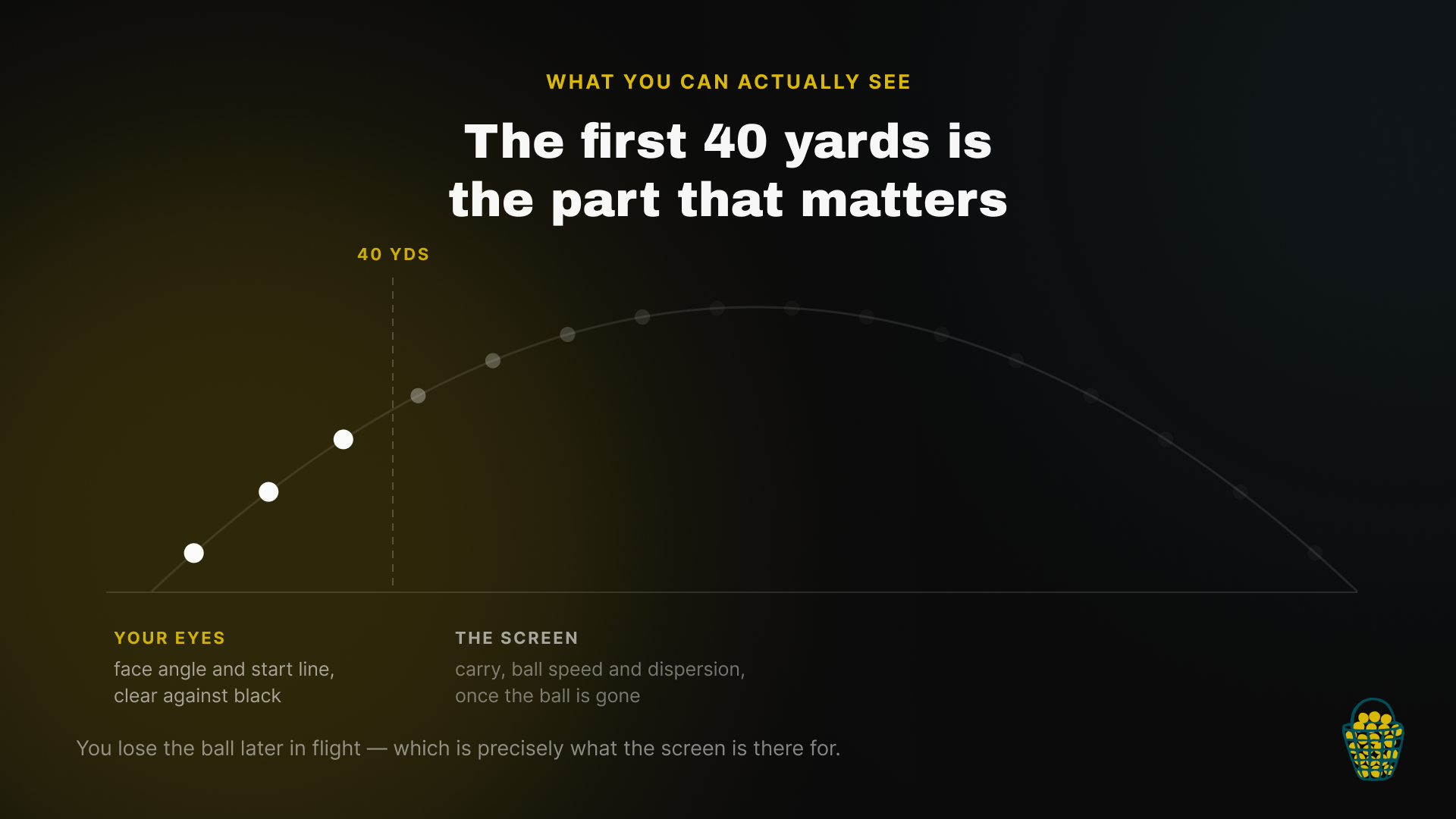
That first 40 yards is the part you can see clearly under the lights, and it happens to be the part that tells you the most. Face angle and start line show up immediately when there's nothing else in the frame competing for your attention.
Watch it enough and you stop guessing. You learn what a pure one looks like coming off the club, and that's something you can go looking for in daylight afterwards.
A golf sim will give you the same numbers indoors, and plenty of people prefer it that way. What's different outdoors at night is that you're watching a real ball do a real thing, and the first read is yours before the screen confirms it. If you're planning a cookout after the session, it's worth running through a safe grilling checklist first.
Developing a feel for the strike
There's a practical side to this too. No midday sun means no sweaty hands, and a grip that isn't slipping is a grip you can repeat. Tempo settles down when you aren't fighting the heat for it.
You might buy the club at golf superstores, but the range is where you find out what it actually does in your hands. That part hasn't changed and isn't going to.
The other thing about a night range is that it's quieter. Fewer people, less noise, nothing to look at past the lights. It's just you and the dirt, which either appeals to you or it doesn't.
Why Toptracer is non-negotiable at night
Once it's properly dark, you can't follow a drive with your eyes. It goes past the lights and you're guessing.
That's why the screen matters more at night than it does at noon. Visual ball tracing picks up exactly what your eyes just lost, so the session keeps its meaning instead of turning into swinging in the dark.
Precision through tracking
Four numbers do most of the work on a night session:
- Carry distance
- Ball speed
- Launch angle
- Dispersion patterns
Entertainment venues run similar tech for games, and it's a good time. Set up for practice, those same four numbers are the difference between a session that counted and one that didn't.
How to structure your night session
Don't just fire a bucket into the dark. Two minutes of planning is what separates practice from burning calories.
- Ten easy wedges to get your eyes used to the lights.
- Mid-irons next, checking carry consistency on the screen rather than chasing distance.
- A 20 ball data check: one target, record your dispersion, change nothing mid-set.
- Five drives to finish, thinking about the transition and nothing else.
Night golf FAQ
Is it harder to see the ball at night?
No, and for the part that matters it's the opposite. A white ball against a black sky is the clearest look you'll ever get at your launch window. You lose it later in flight, which is precisely what the screen is there for.
Can I get golf lessons at night?
You can book a lesson and the booking page shows which times are open at your location, evenings included where they're offered. Worth remembering the difference between practice and hitting balls either way, because a lesson only pays off if the sessions after it have a plan.
Should I use fitted golf clubs for night practice?
They help, but don't let it stop you turning up. Fitted golf clubs make your numbers cleaner, because the equipment stops adding its own error on top of yours. If yours aren't fitted, the data still tells you plenty about your strike.
Daytime sessions spend half their energy fighting the sun. Night sessions don't.
Some of our locations have lights, so check yours and go see what your game looks like under them. Get a free bucket and find out.

.png)