.svg)



How to Master Your Swing at a Toptracer Driving Range
5 minutes to read
.png)
You have likely had this argument with yourself at the 150 yard marker: is this a smooth 7 iron or a hard 8? If you are still guessing based on range ball flight, you are playing a losing game. Many golfers suffer from mindless bucket syndrome. They hit 100 balls into an open field, see a general direction, and assume they have improved. In reality, they have reinforced a guess. Practicing at a Trackman driving range provides the clarity needed to fix these errors. Trackman runs at Glendale, and our other five locations run Toptracer, which gives you the same kind of numbers.
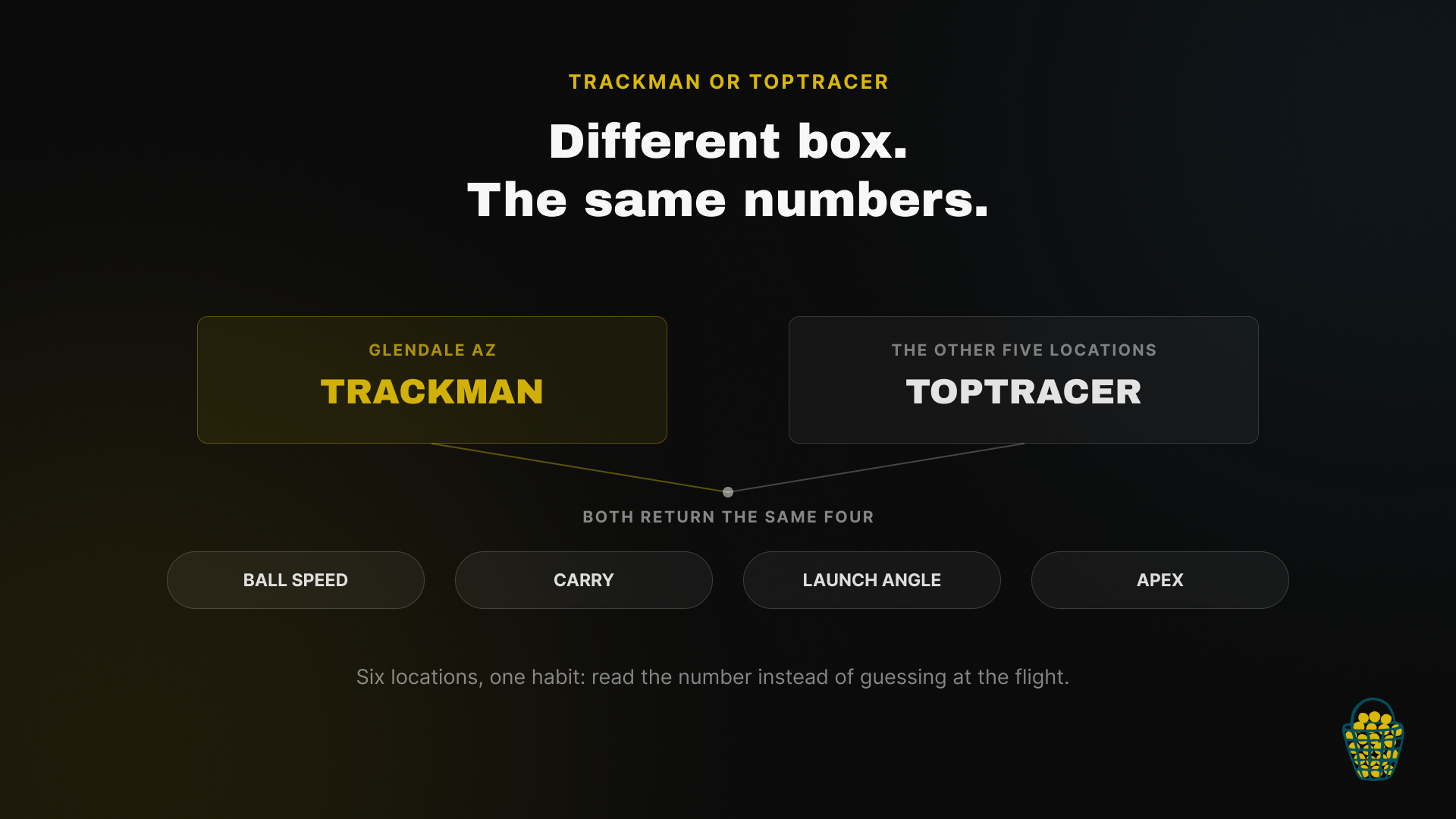
Technological feedback moves you from subjective feel to objective data. Golfers who transition to data driven practice stop overthinking their swing and start trusting their numbers. This is the difference between guessing and knowing. For group event leads and local organizations, this tech also adds a layer of engagement that makes a standard outing feel like a professional experience without the stuffy atmosphere of a private club.
The end of the bucket hitter mentality
Visual flight at a standard range is often a lie. Range balls are frequently limited flight or worn down. Without technology, your eyes cannot accurately judge if a ball carried 145 or 155 yards. There is a clear difference between practicing and just hitting balls. One provides a workout; the other provides a blueprint.
When you step into a bay at Golf Ranch, the transition to data driven practice provides:
- Instant visual feedback on every shot.
- Precise tracking of carry distance versus total roll.
- The ability to save sessions and track progress in your profile.
- Gaming features that turn repetitive drills into pressure situations or friendly group competitions.
Focus on carry distance rather than total distance. Total roll depends on the turf, but carry is the only number that helps you clear a bunker or water hazard consistently.
Standard range versus Trackman practice comparison
Mastering the metrics: what to watch on the screen
One of the biggest mistakes recreational golfers make is focusing on total distance. On a dry range, a ball might roll 20 yards. By knowing exactly how far the ball travels in the air, you eliminate the fear of hazards. This level of detail is what makes the screen worth reading. Whether you are reading it on the bay screen or reviewing it later in your profile, the data remains the primary tool for improvement.
Ball speed is another critical metric. It provides a window into your strike quality. If your ball speed drops while your swing feels fast, you know you aren't finding the center of the face. Using visual tracing allows you to see these correlations instantly. You do not have to wait for your next round to figure out why you are short of every green.
Launch angle determines how the ball interacts with the wind and how it holds the green. Mid handicappers often struggle with a launch that is either too shallow or dangerously steep. By monitoring your apex height on the screen, you can work on a more consistent trajectory.
Understanding these numbers is the first step toward better performance. If you find the data confusing at first, review how to interpret golf data. This helps you avoid getting overwhelmed by the screen. Unlike generic advice, this data is specific to your unique swing.
A 3-step framework for your next session
1. The calibration phase
Hit 10 balls with three different clubs. Ignore the swing mechanics and look at the average carry. This is your baseline for the day using real balls and real turf feel.
2. The target challenge
Use a scored target game on the screen to hit specific yardages. This forces you to control ball speed rather than just swinging at full power. It is the real world math of the game and a great way to engage a group during a social visit.
3. The pressure test
End your session by simulating the first three holes of your favorite course. If the first hole requires a driver and a wedge, hit those exact shots. See if you can execute under self imposed pressure.
Beyond the numbers: the practice experience
Practicing with intent is more effective when the environment matches the technology. Golf Ranch offers covered bays and premium mats that provide a consistent surface. This is a significant improvement over the patchy grass found at many traditional facilities or the indoor hitting bays at golf superstores.
Whether you use a night golf driving range to fit practice into a busy schedule or you want professional grade feedback that translates to the course, the goal is the same. You want to walk onto the first tee knowing your numbers. For those who visit frequently, the Ranch Pass lowers the price of every bucket. When you stop guessing, you start scoring.
Frequently asked questions
How accurate is Trackman?
Trackman is a professional grade launch monitor. It tracks the real ball in flight and returns carry distance, ball speed and launch numbers you can work from directly.
Can I use Trackman for a gap analysis of my clubs?
Yes, it is an excellent tool for determining exactly how far you hit each club. This is essential for choosing fitted golf clubs or deciding if you need a hybrid framework involving both apps and professional coaching from golf lessons with a pga pro.
Is my data saved between visits?
Yes. Your shots save to your profile at the bay, so you can track your swing evolution over time rather than judging a single session.
Stop digging it out of the dirt without a map: data is for anyone tired of wasting practice time.
Grab your first bucket and see the flight for yourself.