
Covered Driving Range in Glendale: Shade Comes First

4 minutes to read

A covered driving range in Arizona starts with shade. At Golf Ranch Glendale we poured the tee line, put up driving range shade structures over all 32 covered driving range bays, replaced 30-year-old netting, and rebuilt the ball system, while the Desert Mirage 9-hole course next door stayed open. The range opened about four months after construction began.
In Arizona, shade is not a nice extra. Without it, nobody wants to stand on a tee line in the afternoon, so when we took over Desert Mirage in Glendale, the covered driving range was the heart of the plan. Everything else in the build either supported those covered bays or had to work around them.
Construction started in October, and the new range opened about four months later. The 9-hole course next door stayed open the entire time. Here is how the build came together, in the order it happened.
We filmed every phase: We Bought a Golf Course. Now What? (Full Build). The whole season, from the first walkthrough to opening day, is in Building a Golf Course from Nothing to Opening Day.
The plan: concrete, shade, then everything else
Our list on day one was short and expensive. Pour the tee line concrete. Add shade, because it is Arizona. Redo the pro shop. Add parking, new cart paths and sidewalks. Run electrical to all of it. The order matters, because the shade structure cannot go up until the concrete is in, and the electrical rides on the shade structure.
Why the tee line is a U, not a V
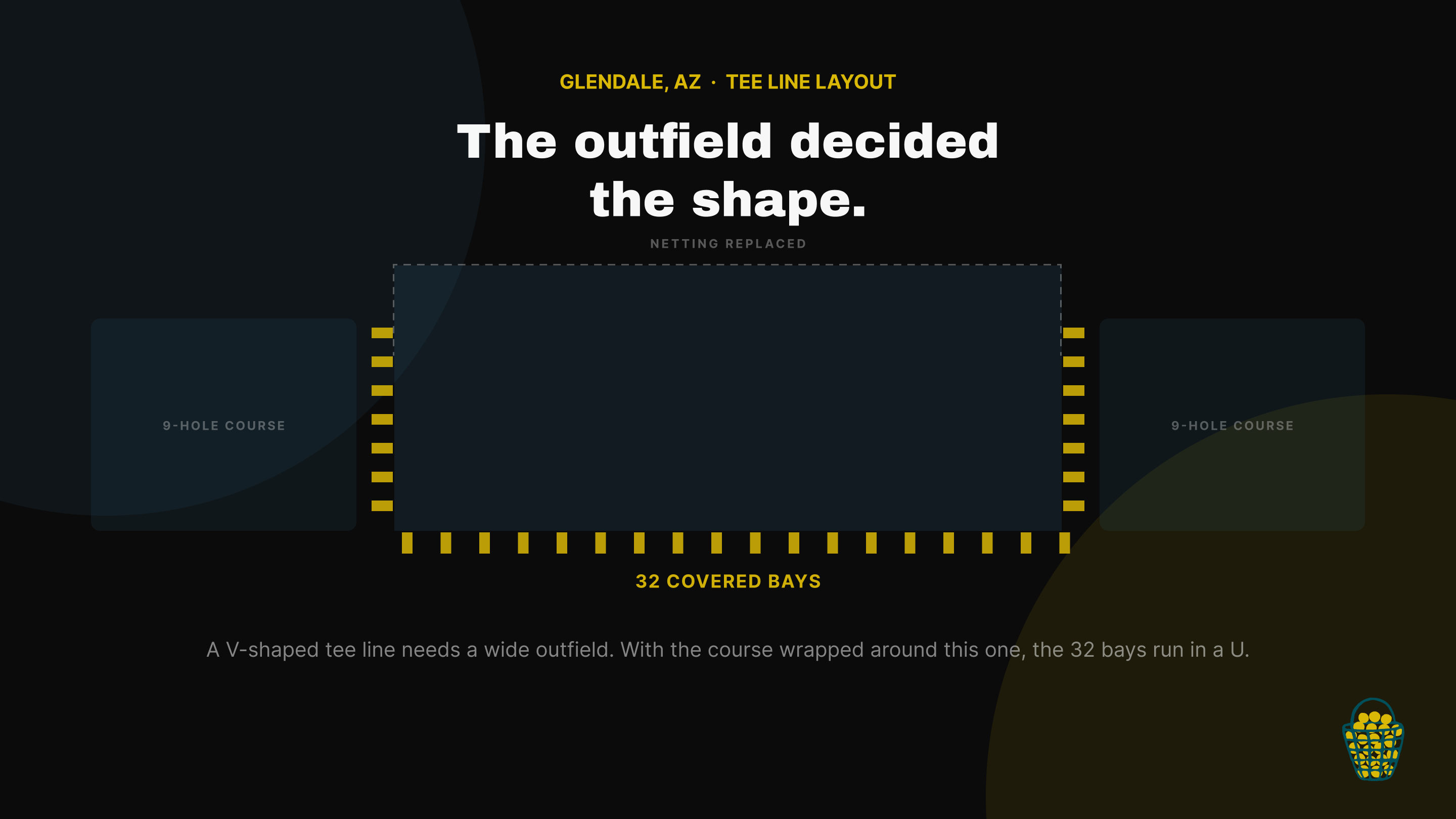
At most of our ranges we build the tee line as a V. Here the shape of the outfield did not allow it, so the 32 bays run in a kind of U, with an extra elbow. The range is deep, and with the course wrapped around it, a ball sprayed far enough left or right could end up on a golf hole. The layout had to keep shots inside the range.
Pouring the tee line
Concrete day is the first big physical step of any range build. Before a single truck arrives, the ground has to be regraded and the forms put up. Then comes the sequence that decides whether the slab lasts:
- Check subgrade compaction and the forms.
- Set the rebar.
- Pour, with the right water and mix for the slab.
- Screed everything flat, then go over it with a bull float.
- Let it cure properly.
Every step has to be right so the slab passes inspection and holds its strength. We left this to the concrete experts. Our job was staying out of the way.
When the weather helps
Winter in Glendale can work in your favor. On one of the big concrete days we got an 80-degree day in January, and the forms poured that morning had already cured by the afternoon. That day we poured the sidewalks, the entryway and the curbs for the new parking, and nearly all the concrete work was done by evening.
Driving range shade structures: how the covered bays went up
For the shade structure we used Cover The Tees. The process is quick once the concrete is ready:
- They drill bore holes into the concrete.
- The verticals go into those holes to carry the roof.
- The aluminum roof goes on top.
The install took a couple of days for all 32 bays. For golfers, the aluminum cover does one job: it gives you a comfortable place to hit balls when the sun is out. For us, it also carries the lights, the fans and the Trackman technology, so we built electrical closets right on the tee line to keep the wiring tidy. If you have ever wondered whether covered hitting bays help when the weather turns, they do the same job against rain.
Covered driving range bays need furniture too
The last touch in the bays was furniture. Most ranges keep the seating to a minimum. We set up picnic tables and high tops so a session feels more like hanging out with friends, plus new mats and bay dividers in every bay. Good hitting mats matter as much as the roof over them.
Netting, poles and a course that never closed
The netting we inherited was about 30 years old, aged and full of holes. Replacing driving range netting is a much bigger job than it sounds. We took down all the poles, moved them from the delivery area down the range into new positions to match the reshaped outfield, and had a crane lift them into place.
Then the new net went up by hand. Each piece of net is clipped roughly every 4 inches, which is slow, manual work across a whole range.
Working around live golf
Because the course stayed open, golfers still had to reach the first tee, and the old route cut straight through the driving range. Before the poles could go in, we poured a new cart path that runs past the range to the first tee. We also put up a protective barrier along the cart path. That barrier was not in the original budget, but with golfers walking and driving next to a live range, we were not going to skip it.
Running construction next to an operating course comes with trade-offs. If a hole has to shut for a week, you may need to discount tee times. Plan for that before you start.
The pro shop, parking and the ball system
The building is much bigger than what we normally work with. Our standard check-in is a shipping container, and this pro shop is about five times that size. We opened it up, removed a lot of small rooms and positioned check-in so you can see the tee line the moment you walk in.
The bathrooms follow the same spec we use at every location. We found a setup that works, and using it everywhere makes reordering simple.
Parking for a course and a range
A golf course and a driving range need parking at the same time. We added roughly 30 spaces in one area and another 70 to 80 across the rest of the lot. Without that, we could not have filled the tee sheet and the tee line on the same afternoon.
Driving range ball dispenser and washer
Next came the ball wash and the driving range ball dispenser. At most sites, the washer and dispenser sit together. Here the cart barn and the pro shop are separate buildings, so after washing, a blower pushes every ball through PVC pipe from the cart barn to the pro shop. We learned that trick on our Grand Prairie build, and it worked well enough to do again.
A covered range looks simple from the parking lot: a roof, some screens and a lot of golfers. Underneath is a slab poured to inspection standard, a structure that carries all the power, and a ball system that keeps the buckets full. That is what made the Glendale bays worth the four months.
Frequently asked questions
How long does it take to build a covered driving range?
Our Glendale build took about four months from the start of construction in October. The shade structure itself took Cover The Tees a couple of days once the concrete was ready.
Why do Arizona driving ranges need covered bays?
Heat. Without shade, a tee line is uncomfortable for most of the day, so shaded hitting bays are what make the range usable year-round.
Are the hitting bays covered for rain?
Yes. All 32 bays at Golf Ranch Glendale sit under an aluminum shade structure, so the same roof that blocks the Arizona sun keeps you dry when it rains. Every Golf Ranch location has covered bays, so you can practice golf year round.
Can a driving range be renovated while a golf course stays open?
Yes, with planning. We poured a new cart path so golfers could reach the first tee and put up a protective barrier along it.
What else is at Golf Ranch Glendale besides the covered bays?
It's a full golf complex. Every bay runs Trackman, Desert Mirage at Golf Ranch is a 9-hole executive course next door (mostly par 3s and 4s, carts included), there's a 6,000+ sq ft all-grass putting green, and the range is open late every day with lights over the bays.
Come see the covered bays in person: visit Golf Ranch Glendale and grab a free bucket on us.