.svg)



The Best Driving Range Mats: Why Your Hitting Surface Matters

3 minutes to read
.png)
A shift is occurring in how serious golfers approach their practice. You flush a 7-iron, but instead of a pure strike, a sharp jolt shoots up your lead wrist. The culprit is frequently the concrete-hard mat beneath your feet. Practice should be productive, not painful. For the performance-focused player, the quality of a hitting surface determines the longevity of the season.
The hidden cost of dead range mats
Traditional ranges often use worn-out mats that offer zero shock absorption. These dead mats are a thin layer of plastic over concrete. When you strike the ball, the energy that should be absorbed by the turf transfers into your wrists, elbows, and shoulders. This leads to chronic joint pain that lingers for days.
I have seen this issue when comparing skill-focused practice environments against entertainment-focused venues where the equipment is secondary to the social experience. The wrong surface turns a session into a physical liability. According to the Mayo Clinic, repetitive impact on hard surfaces is a primary cause of medial epicondylitis, commonly known as golfer's elbow.
Why shock absorption matters
Every time a club makes contact with a hard surface, your joints take a hit. Over a 100-ball bucket, that shock accumulates. Medical research on repetitive impact indicates these forces cause the range hangover that sidelines players. Repetitive impact on poor surfaces causes golfers to develop inflammation before they even reach the first tee.
The bounce-back effect
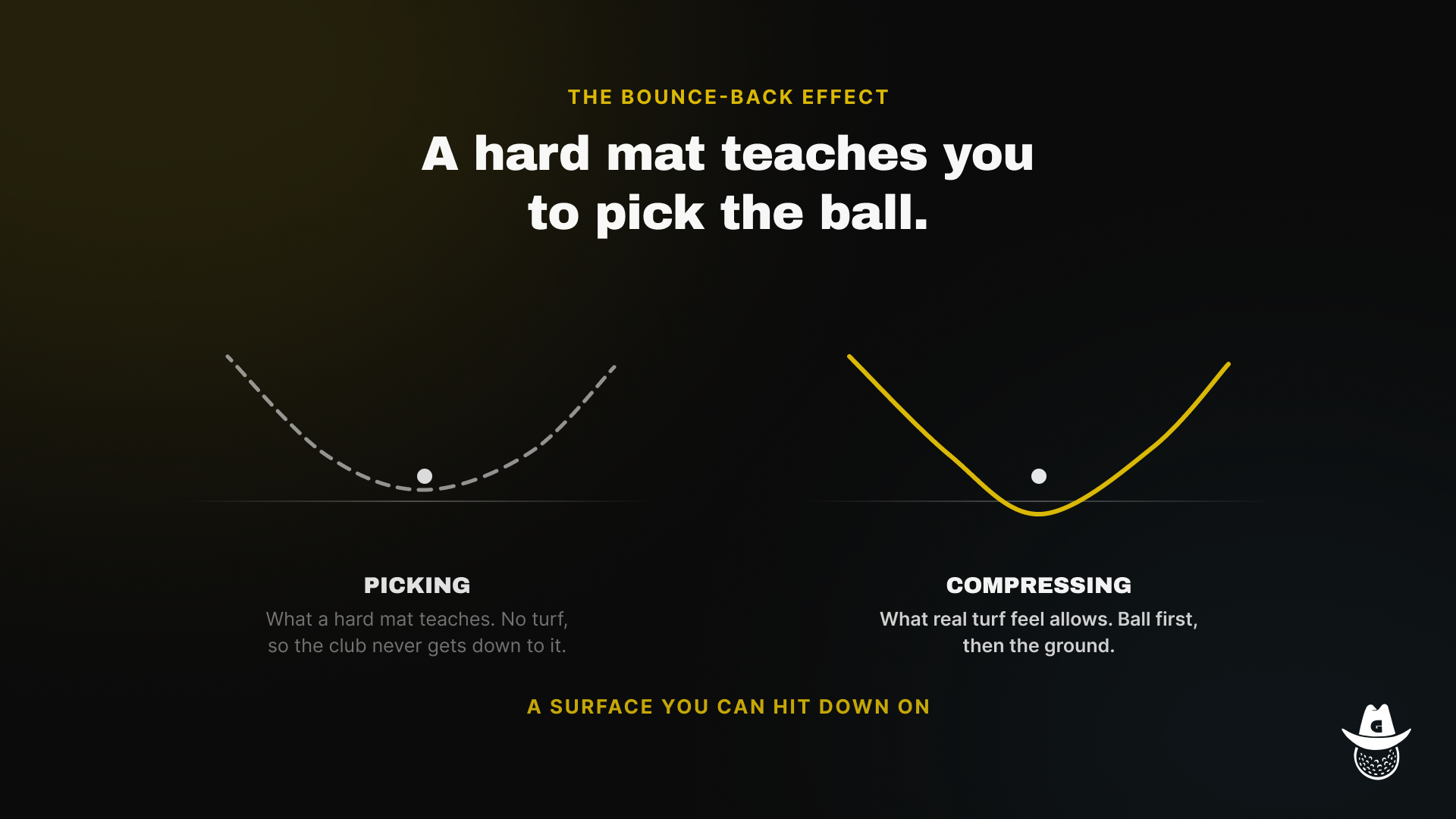
Hard mats ruin mechanics. To avoid the pain of impact, golfers subconsciously start to pick the ball rather than hitting down on it. This destroys natural turf interaction and makes it impossible to practice a compression-based strike that translates to real grass. Choosing a practice-oriented setup that uses quality turf is essential for skill improvement.
How premium surfaces protect your game
High-quality mats and fresh balls are core components of a premium public range experience. Our surfaces mimic the feel of real turf. By providing premium golf practice surfaces, we ensure every swing feels like it is on the fairway while providing a safety net for your joints. Many Golf Ranch reviews highlight how these high-quality surfaces prevent the typical aches associated with long practice sessions.
- Realistic turf feel: Allows you to hit down on the ball without the club bouncing off a hard surface.
- Shock-absorbing layers: We use specialized mats engineered to dissipate impact energy.
- Consistent footing: High-traction surfaces ensure you do not slip during high-speed swings.
- Clubhead protection: Materials prevent the scuffing common on cheaper synthetic grass.
3 ways to tell if a range mat is ruining your swing
- The sound test: If the club makes a loud crack like hitting a sidewalk, the mat is too hard.
- The wrist check: If you feel a dull ache in your lead arm after 20 balls, stop hitting on that surface.
- The ball flight: If perfectly struck shots fly much higher than normal, the mat is likely causing the club to bounce into the ball, giving a false sense of launch angle.
If you are at a range with hard mats, focus on teeing the ball up slightly for all iron shots. It is better to practice your swing path without the pain than to reinforce a picking habit just to save your wrists.
Your joint-friendly practice plan
- Visit a facility with covered hitting bays to maintain a consistent routine regardless of the weather.
- Spend your first 15 balls hitting 50% speed shots to get a feel for the turf interaction.
- Use Toptracer golf data to track your carry distance and ball speed to ensure the mat is not artificially boosting your numbers.
The takeaway
Practice is about improvement. You should not have to choose between a better swing and healthy joints. Visit our facility today to experience the difference a premium surface makes and grab your first bucket free.