
.svg)



The Difference Between Practicing and Just Hitting Balls

4 minutes to read

You just hit 100 balls in 45 minutes, but your game hasn't moved an inch. Most players aren't practicing; they are just emptying a bucket. I see it every day at the range: a golfer steps up, rakes a ball, and fires it into the horizon without a target in mind. For the serious student of the game, structured training is the only path to real progress.
It feels productive because your heart rate is up and the bucket is empty. However, your handicap stays exactly where you left it.
The bucket emptying trap: Why your range sessions aren't working
The myth of muscle memory through repetition
Mindless repetition is often confused with learning a skill. Hitting ball after ball without a pause reinforces bad habits. It does not build useful muscle memory.
When you swing rapid-fire, your body finds the easiest way to finish the bucket. This is rarely the swing you want on the first tee. Effective practice environments provide the space to slow down and treat every shot as its own event.
Why random shots fail to translate to the course
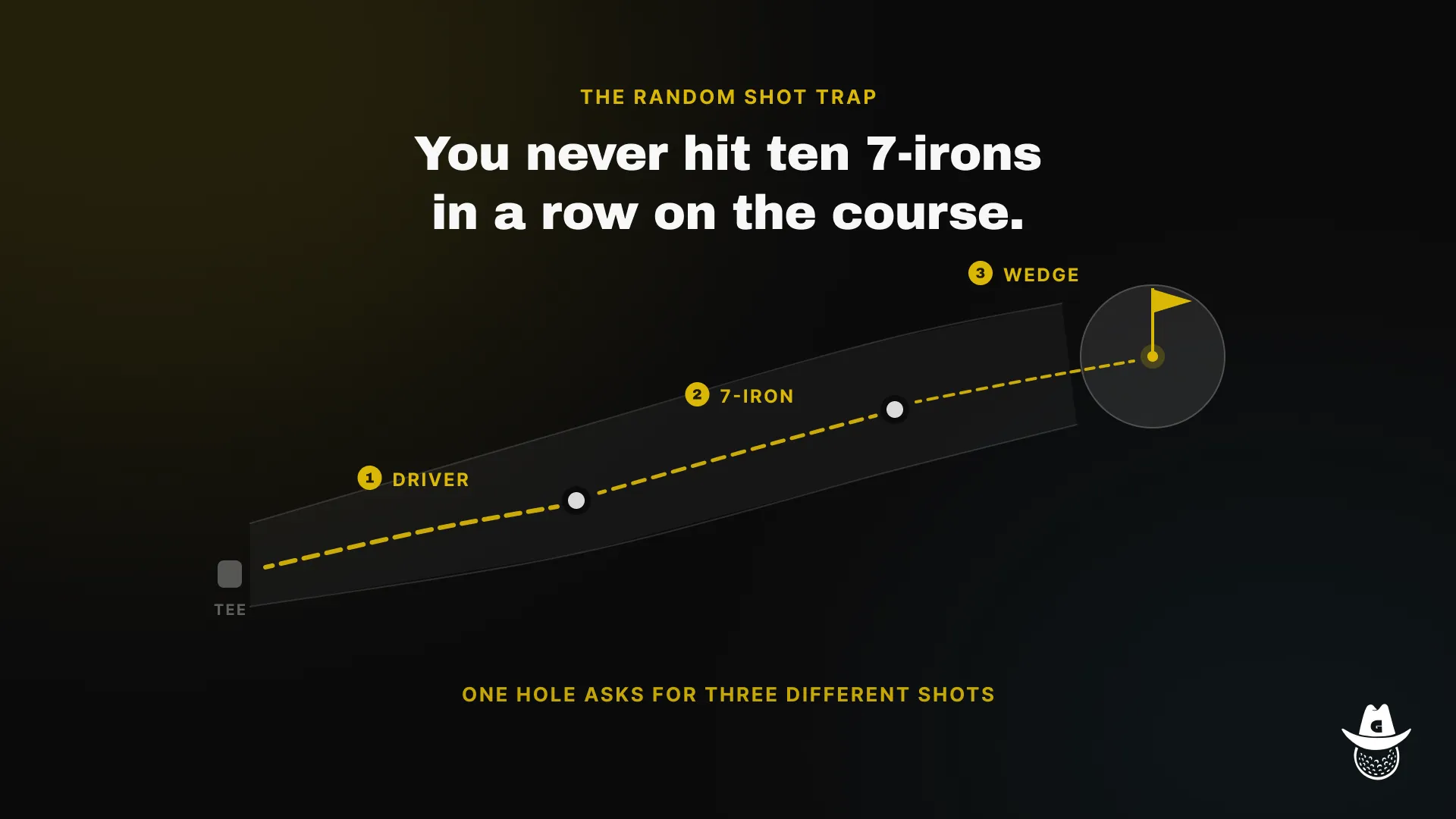
If you hit ten 7-irons in a row, you'll eventually find a rhythm. But you never hit ten 7-irons in a row on the course. This is the random shot trap.
You aren't training your brain for real conditions without a specific target or club changes. You need to simulate actual play to see your handicap improve
Using golf practice facilities for lower scores
To bridge the gap between the range and the course, you need a plan. Moving away from a volume-first mindset to focus on quality is essential. High-quality golf practice facilities offer the tools needed to turn a bucket of balls into a professional-grade training session.
To improve ball striking and mechanics, you should add variety and pressure to every session. (Lefties: flip the alignment cues below, but the logic stays the same.)
How to structure a 50-ball session
- Change your target every five balls to force a setup reset
- Switch clubs frequently to mimic a real hole progression
- Take a full pre-shot routine for at least 20% of the bucket
- Play a virtual hole where you imagine a fairway and a green
- Use technology to verify your carry distances on every club
Why data matters: The Toptracer advantage
Visual feedback is the only way to correct distance and flight path errors accurately. Practice balls can vary in performance. Technology like Toptracer is essential to normalize your data.
When you use practice-oriented shot tracking, you stop guessing. Using a driving range with shot tracking allows you to see the true shape of your shots in real-time. You start knowing exactly why a shot moved the way it did.
Normalizing distance with technology
The most common error is a misunderstanding of carry distance. Technology accounts for the ball type and environmental factors, giving you the numbers you would see with your game ball. To improve golf swing stats, you need consistent data points across every session.
You can track specific metrics including:
Your 3-step intentional practice plan
1. Pick a specific goal
Focus on one thing today, such as mastering your 100-yard wedge carry. Avoid trying to fix your entire swing in one bucket. Even with affordable golf practice, your time is valuable, so spend it wisely on specific drills.
2. Use real-time feedback
Use technology to verify every shot. If the screen says you're missing right, believe it. This allows you to practice golf year round with the confidence that you are building the right habits.
3. Record your patterns
Record your dispersion patterns to identify your natural miss. Knowing your miss is the fastest way to manage your way around a course.
FAQ
Is hitting more balls better for my game?
No. Quality beats quantity every time. Fifty intentional shots are worth more than 200 mindless swings that only serve to reinforce bad habits.
Do I need a launch monitor to get better?
It helps. Using technology like Toptracer removes the guesswork by showing you exactly how far the ball carries and where it lands, regardless of the range ball's condition.
How often should I change clubs at the range?
Frequently. On the course, you never hit the same club twice in a row (unless something went very wrong). Try changing clubs every 3-5 shots to keep your brain engaged.
Hitting balls is a hobby, but practicing is a strategy. Players can shave five strokes off their game by changing how they spend their hour at the range.
Ready to transform your game? Grab a free bucket and start seeing the difference today.
.png)
.png)