
PGA Pro Strategies: How to Transition Range Lessons to the Course

4 minutes to read
Golf lessons only pay off when they survive the first tee. To move range lessons to the course, stop hitting the same club at the same flag, change club and target every shot, run your full pre-shot routine on every ball, and use Toptracer Range games to add pressure. These PGA pro strategies come down to one golf practice plan.
I see it every day at the range: a golfer stripes twenty 7-irons in a row into the sunset, feeling like a tour professional, only to lose that swing the second they step onto the first tee. It's one of the most frustrating disconnects in the game. You develop a rhythmic, repetitive motion on the mat, and it disappears the moment a scorecard is involved. Blame your practice habit before you blame your swing.
To lower your scores, I've found you have to stop being a "range pro" and start training your brain for the grass. That means shifting from technical obsession to target-oriented concentration. By understanding the difference between practicing and just hitting balls, you can make sure the gains from your PGA golf pro lessons actually show up when it matters. For group event leads, the same shift is what makes a corporate outing fun for the team instead of a long struggle through 18 holes. Whether you're a Ranch Pass member or a frequent visitor, making every visit more productive is about value and results.
The block practice trap: why your range session is lying to you
Most golfers fall into the trap of block practice. They pull the same club, aim at the same flag, and hit fifty balls in a row. That builds a groove that feels good but is a poor stand-in for real golf. On the course, you never hit the same shot twice in a row. Block practice builds a false sense of security that fails under the stress of a live round.
The one club fallacy
When you hit the same club over and over, your brain stops solving the problem of the swing and leans on the muscle memory of the previous shot. That's why you feel sharp after ten shots and struggle on the course. Modern swing analyzer apps give you data, but they can't replace a coach who sees this disconnect in person.
To fix it, change your club and your target after every swing. If you just hit a driver, pull a wedge. That keeps your brain engaged and mimics the one-shot reality of the fairway.
Mechanical vs. target concentration
In a golf coaching clinic or a group lesson, you'll see players overthink elbow position or hip rotation. Mechanics matter, but the course asks for target-oriented concentration. Focus on where the ball should go and let the club follow. Visual tracing technology helps you make that shift. When you see ball flight data in real time, you stop guessing and start reacting to the target.
How to use Toptracer Range to simulate a real round
Toptracer Range bridges the gap between the mat and the course. The data gives you objective feedback, though it takes focus to avoid information overload. Learning how to interpret ball flight data is key to prioritizing what to fix first. Toptracer runs at five of our six locations; Glendale runs Trackman.
Playing games that record your score introduces a mild dose of golf performance anxiety, the same feeling that hits on the first tee. Every bucket comes with premium balls and high-quality mats, so the numbers you see are worth trusting.
A golf sim deserves its due: it solves the weather. A covered bay solves the same problem, and it does more for course transfer. A golf simulator reads the first few feet of flight and predicts the rest, while outdoors you watch the real ball climb, curve, and land. A screen also has nowhere to land a chip or roll a putt. Our Glendale, Grand Prairie, and Richardson locations have putting greens, and Richardson has a chipping green. Mats are forgiving and a course never gives you a perfect lie, so treat your range numbers as a best-case baseline.
Practice mode comparisons
The one and done rule: a 3-step practice plan
Next time you visit the range, skip the aimless bucket. Follow this golf practice plan so your golf lessons with a PGA pro stick when you leave the facility:
- Define the target: For every ball, pick a specific flag or marker on the screen. Never hit into an open field.
- Change the club: Never hit the same club twice in a row. Switch from a wood to a short iron to keep your brain active.
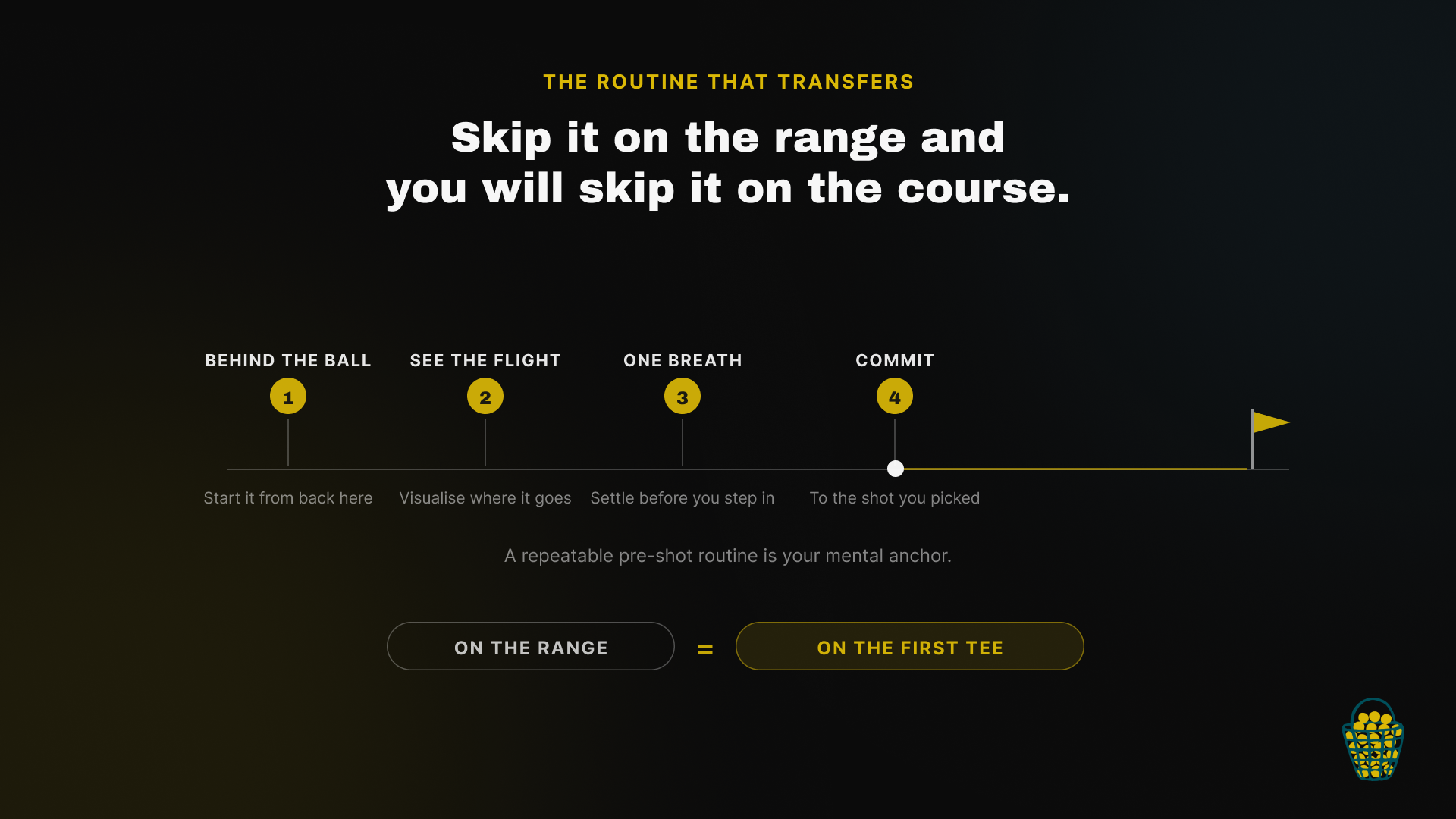
- Perform the routine: Go through your full pre-shot routine for every single ball. If you don't do it on the range, you won't do it on the course.
Building a routine that survives the first tee
Instruction only works when technical gains are paired with the mental ability to execute them under real-game conditions. A repeatable pre-shot routine is your mental anchor. Start it from behind the ball. Visualize the flight, take a breath, and commit to the shot. If you find yourself overthinking, you might need to use techniques for performance anxiety to stay calm under pressure.
Frequently asked questions
How do I take my golf lessons from the range to the course?
Practice the way you play. Change club and target every shot, run your full pre-shot routine on every ball, and use scored Toptracer games for pressure. Block practice feels good on the range, but varied practice is what carries over to the course.
How often should I change clubs during practice?
I recommend changing clubs every shot during the second half of your bucket. The first half is for warming up, but the rest should simulate a round.
Does Toptracer help with putting?
It tracks full shots, so pair it with time on a practice green or a putt putt course for the short game. Glendale, Grand Prairie, and Richardson have putting greens, and Lee's Summit and Brookfield have mini golf.
Can a PGA pro help with my mental game?
Yes. A professional session covers more than your grip. It involves learning how to manage the course and your own expectations.
Come hang out and hit a purposeful bucket to turn your range gains into lower scores. If you want a coach in your corner, our golf lessons start with a 50-minute swing evaluation and a game plan built around it.