.svg)



5 Signs You Should Invest in Professional Lessons in Golf
4 minutes to read
I have spent enough time on the range to know that hitting more balls rarely fixes a persistent slice. The reality is that you cannot out-practice a fundamental mechanical flaw. High-end tech like Toptracer provides insight into your ball flight, but that data is only as useful as your ability to understand it. Recognizing the value of professional guidance is the first step toward transforming your game.
Most golfers cycle through video fixes that never stick. This happens because those generic tips do not address the root cause of an individual struggle. Professional intervention is the fastest path to better golf and lower scores. Five signs tell you when it is time. The first two show up in your scoring, and the last three show up in your body.
The plateau problem: why lessons in golf are essential
The persistent miss
Sign 1: your big miss has not changed in months. I have observed golfers who show up to the range every week and repeat the same mistakes. If your "big miss" is a slice that has not changed in six months, you are not practicing. You are merely reinforcing a bad habit.
A structured golf diagnostic session identifies the problem in minutes. A pro will tell you if that miss is a path issue or a face-angle problem, saving you months of aimless swinging. For those torn between DIY technology and human expertise, a hybrid framework for skill improvement yields the best results.
Inconsistent yardage gapping
Sign 2: you do not know your carry numbers. Performance on the course requires knowing exactly how far every club in your bag carries. If your 7-iron and 5-iron fly the same distance, your mechanics are failing to create proper compression. Golfers who ignore these gaps eventually lose confidence in their club selection. During a golf coaching clinic, you can work specifically on these distance gaps to ensure your bag is properly dialed in.
Professional coaching helps you achieve consistent low point control. This ensures your yardages become predictable rather than a guessing game. If frustration is what is stalling your progress, a coach's job is to give that frustration a direction.
3 signs your swing is risking injury
If you find yourself reaching for ibuprofen after a bucket of balls, your body is sending a warning. Poor mechanics put repeated strain on your joints. Look for these three:
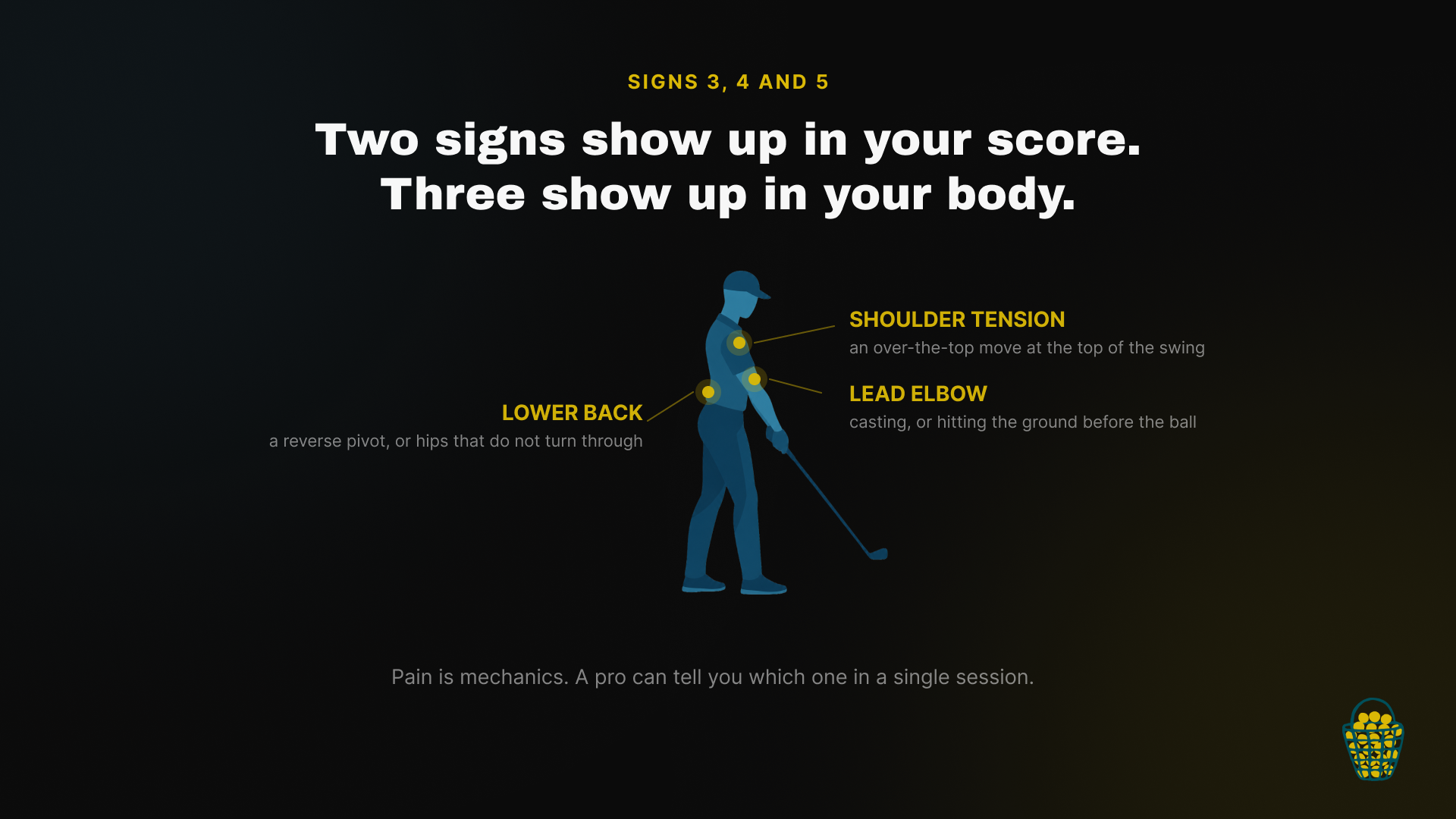
- Sign 3. Sharp pain in the lead elbow, often called golfers elbow, caused by repetitive casting or hitting the ground before the ball.
- Sign 4. Lower back strain resulting from a reverse pivot or improper hip rotation during the follow-through.
- Sign 5. Shoulder tension caused by an over-the-top move that creates unnecessary strain at the top of the swing.
Turning Toptracer data into a game plan
Data collection is easy, but data interpretation is where the change happens. Many golfers look at their dispersion pattern on the bay screen and feel overwhelmed. They see the numbers but do not know which one to fix first. That immediate feedback is only valuable when you have a plan to address what the screen is showing you.
Choosing a practice-oriented environment over a purely entertainment-focused venue ensures the data you collect is actionable. A pro translates those data points into drills that target your specific weaknesses. Instead of just hitting balls, you should be practicing with a specific purpose.
Use the visual feedback from ball flight tracing to track your progress between lessons, but let a professional set the initial benchmarks.
Frequently asked questions
How many lessons do I need to see results?
A single session gives you a baseline diagnostic, and most players need a few consistent sessions after that before the mechanical shift holds up under pressure.
Can I use Toptracer during my lessons?
Yes, our coaches use the integrated technology to show you the immediate impact of swing changes on your ball flight data.
Do I need a membership to book a lesson?
No, professional coaching is available to everyone. We operate on a pay-per-bucket model with no memberships required to access the range or our pros who offer golf lessons from a PGA pro.
Is there an area for families?
While our focus is on game improvement, Richardson has a chipping green, a putting green and a par 3 course, so the short game work stays relaxed and everyone has something to do.
Put it into practice: your first lesson plan
- Record your baseline. Capture a few swings from the down-the-line and face-on views to show your coach exactly what you are working with.
- Book a diagnostic. Schedule a session for professional PGA coaching or PGA golf pro lessons to get an expert assessment of your mechanics.
- Set one goal. Focus on a single outcome, like fixing a slice or improving driver accuracy, to keep your practice sessions structured.
Professional guidance is the fastest path to breaking through performance plateaus. Stop the cycle of frustration and work with a pro who knows the mechanics behind your swing.
Visit the range this week and grab your first bucket free.